

Dental Bridge vs Implant vs Denture: Which Is Right for You?
Medically reviewed by Dr Barry Yu, DMD Penn Pacific Dental Center
Many patients assume that a dental implant is automatically the best way to replace a missing tooth — it's the newest option, so it must be the best one. In practice, the right choice depends on the situation: the condition of the teeth next to the gap, the quality and quantity of the bone underneath, and how comfortable you are with a surgical procedure.
If you're not sure whether the tooth can be saved at all, see our guide on root canal treatment vs extraction.
The best outcome doesn't come from defaulting to one particular treatment. It comes from the treatment plan that suits your situation. Sometimes that's an implant. Sometimes it's a bridge. Sometimes it's a denture.
Is an Implant Always the Best Choice?
Not automatically, even though it's often the option patients ask about by name. An implant is generally preferred when it's both straightforward and worthwhile — good bone quality and quantity, healthy teeth on either side that can be left untouched, and a level of complexity that's justified by the benefit. Surgery itself is also a real factor for many patients, and that's taken seriously: if an implant is a suitable option, it's explained as one, but never pushed. A bridge is usually raised alongside it so you know what else is available.
Where it's less straightforward — for example, when there isn't quite enough bone at the site — an implant may still be technically possible, but the procedure becomes more complex, and that added complexity is worth weighing honestly. No treatment is completely risk-free, and every option involves its own trade-offs. The goal is choosing the option that offers the most predictable result for your specific situation, not the newest one by default. In cases like that, a bridge is often the more predictable option, even if it isn't a perfect solution either.
Not sure which applies to you? An assessment can clarify this quickly.
Or call us: +65 6904 8482
When a Bridge Is Often Discussed
A bridge is often discussed when the teeth on either side of the gap already have large fillings or existing crowns, since treating them together with a bridge can be more efficient than restoring them separately and placing an implant. It's also raised when a patient has a shorter timeline in mind, or would simply rather avoid a surgical procedure.
It's a fixed restoration, so there's no surgery and generally a shorter number of visits than an implant. The trade-off is that the adjacent teeth are prepared and permanently altered to support it — which is why it's suggested when those teeth are already heading that way, not simply because it's the faster option.
When an Implant Is Often Discussed
An implant is often the preferred option when the bone at the site is good quality and quantity, and the teeth next to the gap are healthy. In that situation, it means those neighbouring teeth can be left completely untouched, and the implant itself helps maintain bone at the site over time.
It does mean a surgical step and a longer overall timeline, since the fixture needs time to integrate with the bone before the crown goes on. It's generally considered a predictable option when the anatomy is favourable — the conversation changes when there are complicating factors such as nerve proximity or insufficient bone.
If bone loss is related to gum disease, our periodontal treatment page has more detail.
When a Denture Is Often Discussed
A denture usually comes up when more than one tooth needs replacing, or when a patient wants to avoid surgery or a longer treatment timeline altogether. It's removable, so nothing is done to the neighbouring teeth, and it's typically the fastest of the three options to have made and fitted.
The trade-off is that it needs to come out daily for cleaning and may need adjusting over time as the gum and bone underneath change shape. For patients replacing several teeth or an entire arch, it's often the most practical starting point.
Comparing Bridges, Implants, and Dentures
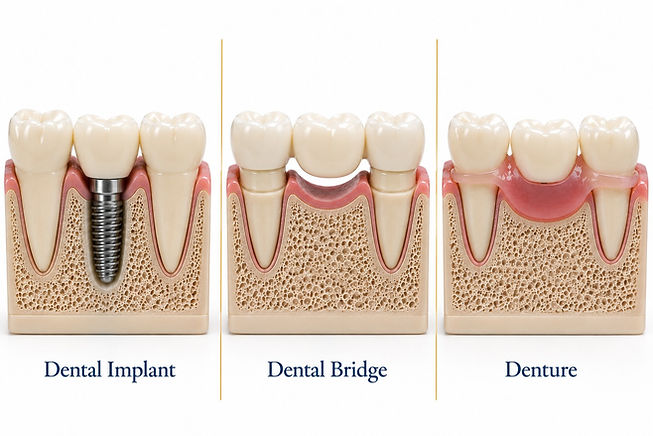
Factor
Dental Implant
Dental Bridge
Denture
Adjacent healthy teeth
Generally left untouched
Adjacent teeth are usually prepared and crowned to support the bridge
Adjacent teeth are not altered, though clasps may rest against some teeth
Surgical procedure required
Yes — a fixture is placed into the jawbone
No surgery; a fixed restoration bonded to prepared teeth
No surgery; a removable appliance
Bone support at the gap
Helps maintain bone at the implant site
Does not directly support the bone at the gap
Does not directly support the bone at the gap
Typical timeline
Longer overall, as the implant needs time to integrate with the bone before the final restoration
Usually the fastest to complete, often over just a few visits
Can take a number of visits and adjustments to get a comfortable, well-fitting result
Daily care
Cleaned like a natural tooth, alongside regular check-ups
Requires cleaning under the bridge, often with a specific flossing technique or a water flosser
Removed daily for cleaning
Number of missing teeth suited to
Often considered for one or a few missing teeth
Most commonly used for one missing tooth or a small gap, though longer bridges spanning multiple teeth can also work well with good case selection
May be considered for multiple missing teeth or a full arch
Frequently Asked Questions
Doesn't an implant always last longer?
Not necessarily. Long-term success depends on choosing the right treatment for the right situation, careful planning, healthy supporting bone and gums, and ongoing maintenance — not simply on it being the newer option. The treatment that suits your specific situation tends to give the best long-term result, whether that's an implant, a bridge, or a denture.
If I choose a bridge now, have I lost my chance of getting an implant later?
Not necessarily. In many cases a bridge doesn't rule out an implant down the line, provided enough bone remains and the site is still suitable at that point. It's worth discussing directly with your dentist if you're weighing this.
Does a bridge damage the adjacent teeth?
A bridge does require the teeth next to the gap to be prepared and crowned, which is a permanent step. This is generally suggested when those teeth already have large fillings or existing crowns and would benefit from that coverage regardless, rather than as a routine first option.
How long does each option typically take?
A bridge is usually the fastest to complete, often over just a few visits. An implant takes longer overall, since the fixture needs time to integrate with the jawbone before the final crown is placed. A denture can also take a number of visits and adjustments before it fits comfortably.
Does insurance or Medisave cover these treatments?
It depends on the treatment and your specific plan or Medisave eligibility. Our team can walk you through what's likely to apply in your case — see our insurance and corporate panels page for more detail.
Is Penn Pacific Dental Center near Tanjong Pagar MRT?
We're at 160 Robinson Road, #05-14 SBF Center, a short walk from Tanjong Pagar MRT (East-West Line). We're also accessible from Shenton Way MRT (Thomson-East Coast Line) and Telok Ayer MRT (Downtown Line) — convenient for a consultation during a lunch break or before/after work.
About Dr Yu

Dr Barry Yu, DMD — focuses on microscope-assisted endodontics and restorative treatment planning.
Not Sure Which Option Fits Your Situation?
The best treatment isn't always a particular procedure — it's the plan that suits your specific situation. During your consultation, we'll assess the condition of the teeth around the gap, your bone support, and your own priorities before recommending what's actually appropriate, rather than defaulting to the same option for everyone.
WhatsApp us or book an appointment to discuss your options with our team.
Or call us: +65 6904 8482