

Root Canal and Endodontic Treatment
Where Would You Like to Start?
This page gives an overview of root canal and endodontic-related treatments. If you know what you are looking for, use the links below to go directly.
Emergency Pain and Dental Trauma
Dental pain or trauma can develop quickly and may need early assessment. Severe toothache, facial swelling, a cracked or broken tooth, or pain following an injury are all reasons to seek early assessment.
If you are in pain now, WhatsApp or call us and we will advise how soon you should be seen based on your symptoms.
If swelling is spreading to the jaw or neck, you have a fever, or you are having difficulty swallowing or breathing, seek medical attention immediately. Do not wait for a dental appointment.
Next step: read more about emergency dental care at Penn Pacific, or contact us directly.
Same-day appointments are subject to availability. WhatsApp us to check.
Dental Abscess and Incision and Drainage
A dental abscess is a localised infection that develops when bacteria reach the inner part of the tooth or the surrounding tissue. It can cause persistent pain, swelling, and in some cases a visible pimple on the gum.
When an abscess causes significant swelling or pressure, incision and drainage may be performed to relieve the buildup and reduce discomfort. This is not a standalone cure — it controls the immediate situation while the underlying cause is addressed, usually through root canal treatment or extraction.
If you have swelling near a tooth, pain that does not settle, or a pimple on the gum that keeps returning, these are signs that the tooth needs to be assessed.
Next step: read more about dental abscess in Singapore, or contact us to arrange an assessment.
Vital Pulp Therapy and Pulpotomy
Vital pulp therapy refers to procedures that aim to preserve some or all of the living pulp tissue inside a tooth, rather than removing it entirely as in a full root canal.
A pulpotomy involves removing only the affected portion of the pulp — usually in the crown of the tooth — while leaving the root pulp intact. This is more commonly considered in back teeth where the pulp exposure is recent and the remaining tissue is healthy.
A direct pulp cap involves placing a protective material over a small pulp exposure to encourage healing without removing pulp tissue.
These procedures are not always appropriate and depend on factors including the extent of the decay, the condition of the remaining pulp, and the patient's age. An assessment helps determine whether vital pulp therapy is a suitable option or whether full root canal treatment should be considered instead.
Next step: if you have been told you may need a root canal, read more about how we assess and treat teeth at Penn Pacific.
Root Canal Treatment
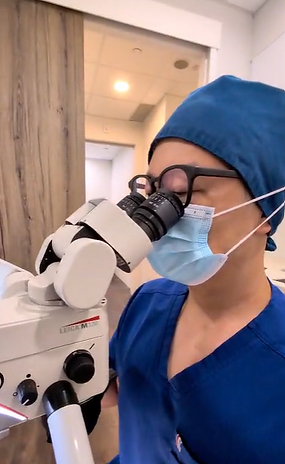
Root canal treatment involves removing the inflamed or infected pulp from inside a tooth, cleaning and shaping the canal system, and sealing it to prevent reinfection. The tooth is then restored — usually with a crown — to protect it and restore function.
Treatment is carried out under local anaesthesia. At Penn Pacific, all root canal treatment is performed under a dental operating microscope. The canals are small and canal anatomy can vary, so working under magnification supports more thorough assessment and treatment.
Root canal treatment is usually considered when the pulp is irreversibly inflamed or infected, or when there is evidence of periapical infection on X-ray. An assessment and X-ray are needed to confirm whether treatment is appropriate.
In some cases, the decision is between root canal treatment and extraction. Both are valid options depending on the tooth condition, and the pros and cons of each can be discussed at your appointment.
Next step: read more about root canal treatment at Penn Pacific, including what to expect and how costs are structured.
Root Canal Retreatment
A tooth that has had root canal treatment can sometimes develop new symptoms months or years later. Pain on biting, swelling near a previously treated tooth, or a recurring pimple on the gum may indicate that the original treatment needs to be revisited.
Retreatment involves removing the existing filling material from the canals, reassessing the internal anatomy, disinfecting, and resealing. In some cases, previously missed canals or unresolved infection are identified during retreatment.
Not every tooth that has had a root canal and is causing discomfort requires retreatment. An assessment helps identify the cause and determine the most appropriate next step.
Next step: read more about root canal retreatment at Penn Pacific.
After Root Canal Treatment
After root canal treatment, the tooth usually needs to be restored with a crown. A root canal-treated tooth can become more brittle over time, and a crown helps protect it from cracking under biting forces.
Mild soreness in the area for a few days after treatment is common. If pain is worsening after 48 to 72 hours, or if swelling develops, contact the clinic.
Regular dental reviews help monitor the long-term health of a root canal-treated tooth.
Next step: read more about crowns after root canal treatment, or what to expect if you have tooth pain after a root canal.
Root Canal Treatment at Penn Pacific

Root canal and endodontic-related treatment at Penn Pacific is carried out by Dr. Barry Yu. Dr. Yu has been practising since 2007 and has undertaken postgraduate training in endodontics. All root canal treatment is performed under a dental operating microscope.
CBCT scans are used when needed for diagnosis and treatment planning.
Next step: read Dr. Yu's full profile, or book an appointment.
Frequently Asked Questions
How do I know if I need a root canal?
Persistent toothache, pain when biting, prolonged sensitivity to hot or cold, swelling, or a pimple on the gum near a tooth are common signs. An assessment and X-ray are needed to confirm. Read more about how we assess whether a root canal is needed.
Is root canal treatment painful?
The procedure is carried out under local anaesthesia. Some mild soreness in the area for a few days afterwards is normal. Most patients find the procedure more manageable than they expected.
What is the difference between root canal treatment and retreatment?
Root canal treatment is done when the pulp becomes infected or inflamed for the first time. Retreatment is done when a previously treated tooth develops a new infection or persistent symptoms.
Can a root canal-treated tooth last a long time?
With proper restoration and regular dental reviews, a root canal-treated tooth can remain functional for many years. A crown is usually placed after treatment to protect the tooth.
What happens if I leave an infected tooth untreated?
Infection in a tooth does not resolve on its own. Left untreated, it can spread to surrounding tissue and bone. Early assessment and treatment help limit the extent of damage.
Do you use a microscope for root canal treatment?
Yes. All root canal treatment at Penn Pacific is performed under a dental operating microscope. Read more about the microscope at Penn Pacific.
Book an Assessment
If you have tooth pain, swelling, or have been advised to consider root canal treatment, contact us to arrange an assessment. We are at 160 Robinson Road, #05-14 SBF Center, a short walk from Tanjong Pagar MRT.
Phone: +65 6904 8482 Email: info@ppdental.com.sg